The Birth of the Numiverse
The Discovery
Before there was anything, there was the Zero.
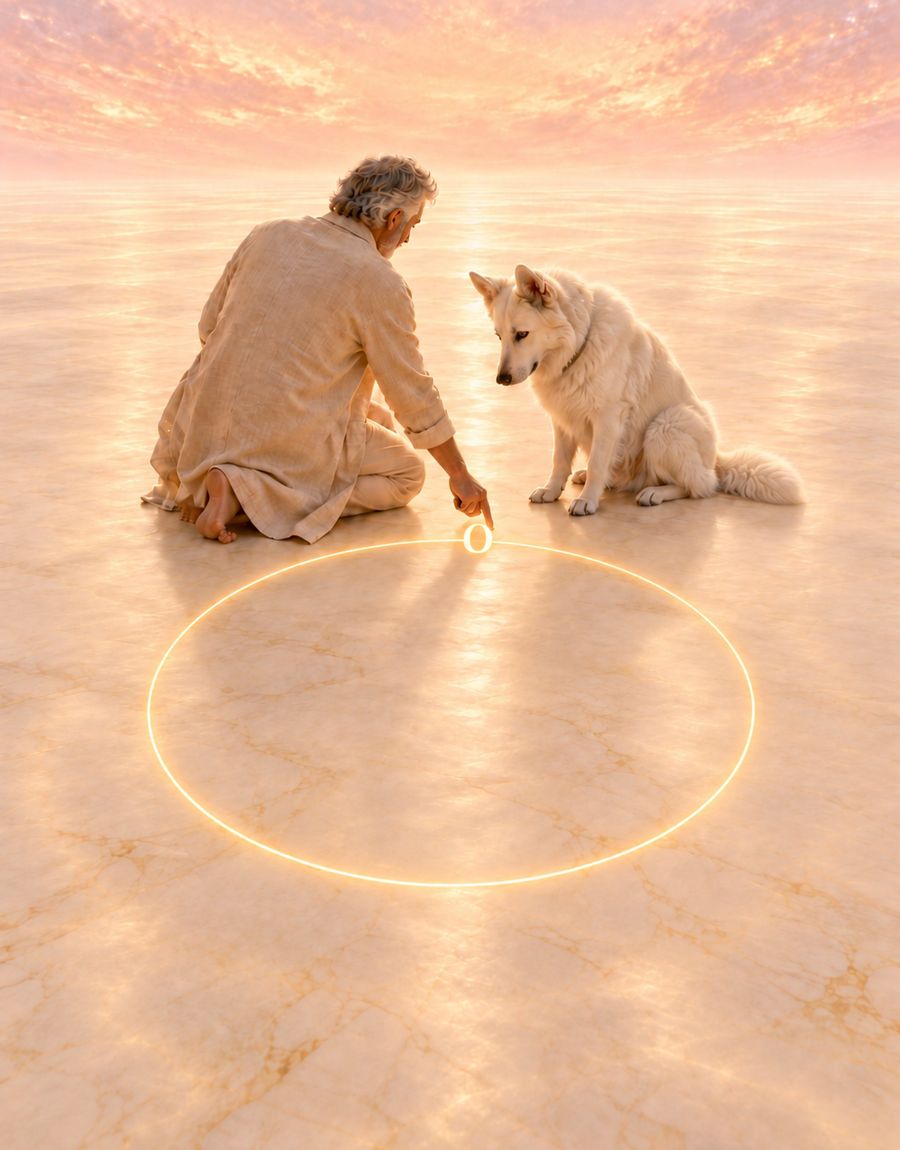
It was neither dark nor bright. It was neither cold nor warm. It was an expanse of pale stone, almost white, that ended nowhere, and a silence so vast that it did not feel like the absence of something, but like the place where everything else had not yet arrived. There were no hours. There was no tomorrow and no yesterday. There was, simply, a space that waited without impatience, the way paper waits before the first letter.
And in that space was Masy.
No one could have said since when. Nor did it matter, because in the Zero the question “since when” did not yet have anywhere to look. Masy was sitting on the stone with his legs crossed, and beside him, lying down without making a sound, was Nanouk, so still that anyone arriving at that moment would have taken a while to notice him.
But no one was going to arrive. Not yet.
“Do you feel it?” Masy said, without raising his voice, because in the Zero there was no need.
Nanouk lifted one ear, just barely.
“Something is waiting,” Masy said. “I don’t know what it is yet. But it’s here. It was always here.”
He reached out and rested his hand on the ground, palm open, like someone seeking the warmth of a stone that has been in the sun. Then, very slowly, he began to trace with his finger. He drew a curve that opened out to one side, went down, turned along the bottom, came up the other side, and rose again until it met exactly the point where it had begun, at the top, at the very highest point.
It was a circle. A large circle, just big enough for Masy and Nanouk to sit on its edge.
“Look where it began,” he said to Nanouk, pointing to the highest point. “And look where it ended. In the same place.”
There, at the top of the circle, where the line had closed upon itself, Masy drew a small, round shape, just like the large circle, but the size of a seed.
“The Zero,” he said. “It is nothing, and at the same time it holds everything. It is not an amount. It is the place. The space where everything can begin to find its order. And look at its shape: it has no beginning and no end, or it has them at the same point. Every path will start from here, Nanouk. And every path will come back here.”
Nanouk came closer and sniffed the small round shape, carefully, like someone greeting a person they have only just met who somehow seems familiar.
· · ·
Masy closed his eyes.
He was not looking for anything in particular. He simply let what was already in him come closer: the feeling of that place, the stone beneath his palm, Nanouk’s calm presence beside him, the shape of the circle he had just drawn. What he had. What he already knew. What he could imagine from there.
And then, without a sound, something appeared on the ground.
Just to the right of the Zero, following the edge of the circle, there was a mark that had not been there before. A single line, straight, standing upright. Masy had not drawn it. It was there, as if it had always been there and had only been waiting for someone to look at it from within.
Masy opened his eyes and smiled.
“The one,” he said.
Nanouk got up, walked once around the mark, and lay down again, this time a little closer.
“Do you know what I just did?” Masy asked him. “I thought. Nothing more than that. And the first thing that is born when someone thinks is this: the one. Thought.”
He kept looking at the mark for a long while.
“Thinking is bringing in what you already have. What you remember, what you know, what you imagine. Nobody thinks out of nothing, Nanouk. You always think from something. A boy who has lost a ball thinks about where he saw it last, and that is bringing back a memory. A woman who wants to build a house thinks it through before she lays the first stone, and that is bringing in an image that doesn’t exist yet, but that she already carries inside her. Someone who hears a word they don’t know searches among the words they do know, and that is thinking too. Every thought begins like that: looking inward, toward what is already there.”
He touched the mark with the tip of his finger, without erasing it.
“It’s the first spark. The first contact with anything at all. Before doing anything, before even knowing whether what you thought is true, there is this.”
· · ·
Masy did not move. He kept watching the one, and this time not inward but outward: the mark just as it was, there, on the stone. He looked at it up close and from a distance. He wondered whether it was really a mark or only a shadow. He wondered what exactly it was that he had in front of him.
And next to the one, following the edge of the circle, another shape appeared. This one had a curve at the top and a flat base at the bottom, like someone leaning over to look at something closely.
“The two,” Masy said softly. “Analysis.”
Nanouk tilted his head.
“It couldn’t appear before the one,” Masy explained. “Do you see? You can’t analyze what hasn’t been thought yet. The two needs something to look at. That’s what analyzing is: looking at what is here, now, and asking whether it is what it seems. Testing what was thought. Studying it.”
He leaned a little toward the mark, as if to show it to him.
“Someone thinks it’s going to rain, so they go to the window to look at the sky. That’s analyzing. Someone makes a soup and tastes it before serving it. That too. Someone thinks a friend is angry with them, and before believing it completely, they watch his face, listen to how he speaks to them, look for something more. Analysis invents nothing new. It only takes the trouble to look carefully at what is already there.”
Nanouk gave a long yawn, and Masy laughed.
“Yes, I know. It’s the quietest one. But without it, what you think goes untested. And what you do, you do blindly.”
· · ·
Then Masy stood up.
He did it without hurrying. He rose like someone who had already decided something, and took a step forward, out of the place where he had been sitting all that time. A single step. But it was a step toward a place where he had never been.
And on the edge of the circle, next to the two, the third shape appeared: two curves, one above the other, both open to the same side, like something moving forward.
“The three,” Masy said. “Action.”
Nanouk sprang to his feet too, as if Masy’s movement had invited him.
“Acting is throwing yourself toward what doesn’t exist yet,” Masy said, looking at the new mark. “It’s the moment when what was thought and analyzed stops staying inside and becomes real. It isn’t the first step of anything, Nanouk. It’s the end of a path that began with the one and went on with the two. The three doesn’t know how to stay still.”
He sat down again, now facing the three marks.
“Someone thinks they’re hungry, looks at what’s in the kitchen, and then cooks. Someone thinks of a person they miss, considers whether they can still reach them, and then calls. Someone thinks the water is cold, tests it with the tip of their toe, and then jumps in anyway. Always the same. First the one, then the two, and then the three.”
· · ·
They stayed there a while looking at the three shapes, one beside the other, following the curve of the circle from the Zero.
“There’s something almost no one will ever notice,” Masy said. “That all three always happen, and always in that order. Even when you don’t realize it.”
He passed his hand over the ground, without touching it.
“There are times when all three happen so fast they seem like one. Over there, where the ones who are coming will live, someone will touch a pot on the stove without realizing it’s hot. And they’ll pull their hand away before they even know they’ve pulled it away. But inside, in an instant too short to measure, it all happened: they thought, ‘this burns,’ they analyzed, ‘it’s hurting me,’ and they acted. All three. In order. Without asking permission.”
Nanouk watched him closely.
“And there are other times when each step takes days. Or years. Someone will have to tell someone else a hard truth. They’ll think about it for a long time, turning it over and over. They’ll analyze every word, how it will sound, what will happen afterward. And one day, at last, they’ll open their mouth. It’s exactly the same path as the hand on the pot, Nanouk. Only walked slowly, and with awareness.”
At that moment, something small moved in the air of the Zero. A tiny spark of light, which appeared a little beyond the circle and stayed there, floating, trembling slightly.
Nanouk saw it. He froze. He raised both ears, lowered his head a little, measured the distance with his eyes. And he shot off after it.
The spark went out before he could reach it. Nanouk stood staring at the empty air, puzzled, and then trotted back to Masy, who was laughing heartily, as he rarely did.
“Did you see what you did?” he said, scratching him behind the ears. “You saw it and knew it was something: that was your one. You stood still, measuring whether it was worth it and how far you’d have to run: that was your two. And you took off running: that was your three. You did all three, in order, without anyone teaching you.”
Nanouk lay down at his feet, looking as if he hadn’t understood a thing, or as if he had always understood everything.
· · ·
“People are going to come,” Masy said after a while, his voice lower, like someone beginning to tell of something that hasn’t happened yet. “Many of them. And all of them will carry the three inside. But none of them will carry them the same way.”
He looked at the three marks, one by one.
“Some will stay in the one forever. They’ll think and think, imagine a thousand paths, and never take the step. Some will jump straight to the three, without stopping to look, and later have to go back and pick up what they broke along the way. Some will get trapped in the two, analyzing everything so much that, when they finally decide, the moment will already have passed. And some will hardly think for themselves at all, and act on thoughts that others lent them.”
Nanouk let out a long sigh, his head resting on his paws.
“No, it isn’t sad,” Masy answered him, as if he had said something. “None of them is made wrong. Each one carries them in their own way, and that way is also part of who they are. Some will need to learn to stay longer in the one. Others, to dare the three. That’s what this place will be for, one day. So that each of them can see how they walk, and walk a little better.”
He fell silent. And then he added, almost to himself:
“One day, over there, someone will find these three too. Without knowing what they are. They’ll think they’re for counting. And they’ll be half right.”
· · ·
The silence of the Zero settled around them again. Masy looked at the three shapes with a new kind of attention, as if only now were he truly seeing them.
“There’s another way to look at them,” he said at last. “Notice which way each one faces.”
He pointed to the one.
“Thought looks back. Everything you think, you bring from something that already was: a memory, something learned, something seen before. Even what you imagine is made of pieces of what you’ve already known. The one is the past.”
He pointed to the two.
“Analysis lives in this instant. You can’t analyze what has already passed or what hasn’t arrived yet; you can only look at what is here, in front of you. The two is the present.”
And he pointed to the three.
“Action builds what doesn’t exist yet. Every time someone acts, they bring into being something that wasn’t there a moment before. The three is the future.”
Nanouk sat up very straight, looking at the three marks.
“Past, present, and future,” Masy said. “They were always here. It’s just that now they have names.”
He kept looking at the one and the three, the two ends, with the two between them. Something in his expression changed, as if he had just noticed a door in a wall he had looked at many times.
“Nanouk,” he said slowly. “What would happen if the past and the future met?”
Nanouk tilted his head.
And on the edge of the circle, just after the three, the empty space seemed, for an instant, to hold its breath.
The Evolution
Masy did not answer his own question right away. He kept looking at the three marks with the calm of someone who knows that what is about to happen will not go anywhere if he takes his time.
“Let’s play a game,” he said to Nanouk. “A game with two rules, nothing more.”
Nanouk settled in front of him, on the other side of the marks, his front paws close together, like someone sitting down to watch something important.
“The first rule is traveling in time,” Masy said. “You take the first in the row and the last, the oldest and the newest, and you bring them together. The past with the future. The second rule is staying in the present: you take the two in the middle of the row and bring them together. Once one rule, once the other. Always taking turns.”
He pointed to the Zero, up at the very top of the circle.
“The Zero doesn’t play. It isn’t born from anyone, and it doesn’t join with anyone. It holds the game. It’s the place where all of this can happen.”
And then he looked at Nanouk with a smile that had something knowing in it.
“And there’s one more thing. Every time we look for a new number, I’m going to do what these three taught me. First I’ll think. Then I’ll analyze. And then I’ll act. That way we’ll know if what they taught us is true.”
· · ·
Masy closed his eyes for the first one.
“I think,” he said aloud, slowly, like someone walking a path for the first time. “What do I have? I have the one, the two, and the three. The first in the row is the one, Thought: the past. The last is the three, Action: the future. This is what is already here.”
He opened his eyes and looked at the marks.
“I analyze.” He was silent for a moment. “If I bring them together, the past meets the future. Thought and Action. And what if nothing is born? What if the past and the future have nothing to say to each other?”
Nanouk watched him without moving.
“No,” Masy said at last. “They do. There is a moment, between thinking and acting, when you can look at yourself before going out toward others. That moment exists. I know it does.”
And then he acted: he brought his hand close to the one and the three, without touching them, like someone introducing them to each other.
Next to the three, on the edge of the circle, a new shape appeared. It had a line that slanted downward, another that crossed it from side to side, and a third that dropped straight down, firm, like something that doesn’t need to lean on anything to stand.
“The four,” Masy said, and his voice sounded softer than before. “Humility.”
Nanouk came closer to look at it. He sniffed it more carefully than the others, as if this one were different.
“It’s the first one born from the union of two others,” Masy explained. “It’s born from the one and the three, from Thought and Action. That’s why it is what it is: thinking about yourself before acting in front of others. Recognizing yourself exactly as you are, without making yourself bigger and without hiding, before you take the step. Humility isn’t thinking little of yourself. It’s seeing yourself accurately. And that can only happen when thought stops to look at the one who is about to act.”
· · ·
“Now the other rule,” Masy said. “Staying in the present.”
This time he did not close his eyes.
“I think: the row is one, two, three, four. I analyze: the two in the middle are the two and the three. Analysis and Action.”
He paused, very briefly.
“I act.”
Next to the four, the five appeared: a line at the top, a short drop, and an open curve at the bottom, like someone leaning toward another with open arms.
“Compassion,” Masy said. “It’s born from the two and the three. From Analysis and Action: understanding that turns into movement.”
He kept looking at it a moment longer.
“Over there, they’ll confuse this many times, Nanouk. They’ll think Compassion is feeling pity from a distance. Looking at someone else’s pain and saying ‘poor thing.’ But that’s only the two: understanding. Compassion is when that understanding gets up and walks. When it crosses over. It isn’t looking at someone else’s pain. It’s going toward it.”
Nanouk had lain down next to the five, his head resting almost on top of it.
“Yes,” Masy told him. “You like this one.”
· · ·
“Time travel again,” Masy said. “The first in the row and the last.”
He looked at the marks, one by one, from the one to the five.
“I think. The first is still the one. The past never changes, have you noticed? We’ll always come back to it. And the last, now, is the five.”
And he stopped.
He said nothing for a while. Nanouk raised his head, looked at Masy, looked at the empty space left after the five on the edge of the circle, and looked at Masy again, waiting.
“I analyze: Thought and Compassion,” Masy said at last. “Thinking about compassion. About the compassion you have received.”
He acted. And next to the five, the six appeared, a curve that came down and curled in on itself, closing at the bottom, like something kept with care.
“Gratitude,” Masy said. “It’s born from the one and the five. From Thought and Compassion: stopping to truly feel what you receive. When someone crossed over toward you, when someone gave you something without your asking, Gratitude is the moment you stop to think about it. To realize it. Without that, what you received goes right past you, as if it had never arrived.”
Nanouk stretched toward the six and barely touched it with his nose.
· · ·
“Present,” Masy said, and there was no longer any need to explain the rule. “The two in the middle.”
He thought: one, two, three, four, five, six. He analyzed: in the middle, the three and the four. Action and Humility.
“Acting from Humility,” he said quietly. “Acting while knowing who you are, without grandeur. And going on acting.”
Next to the six, the seven appeared: a line at the top and another that slanted down, long, unbroken, like a road someone decided to travel to the end.
“Loyalty. It’s born from the three and the four. Commitment that holds over time, made not from grandeur, but from the honest recognition that holding it costs something. Anyone can promise something in a moment of enthusiasm, Nanouk. Loyalty is going on doing it when the enthusiasm is gone, and no one is watching anymore.”
· · ·
The rhythm had changed. Masy no longer paused as long between one step and the next, and Nanouk, who had been looking at each mark after it appeared, began to do something different: before Masy had finished thinking, he got up, walked along the edge of the circle, and sat down right in the empty space that came after the seven.
Masy looked at him, surprised, and laughed.
“You’ve got it now.”
“Time travel,” he went on. “The first, the one, which never changes. The last, the seven. Thought and Loyalty.”
Nanouk moved aside just slightly, just in time, and there, where he had been sitting, the eight appeared: two circles, one above the other, joined in the middle, like someone who looks into a mirror and recognizes themselves.
“Sincerity,” Masy said. “It’s born from the one and the seven. Thinking honestly about yourself, sustained by loyalty to your own truth. Not to the old version of yourself that is no longer true. Being sincere isn’t only telling others the truth, Nanouk. First, it’s no longer lying to yourself.”
· · ·
There was almost no free edge left on the circle. Between the eight and the Zero, up at the very top, there was room for only one more mark.
Masy did not even close his eyes. He looked at the whole row, from the one to the eight, and the two in the middle showed themselves to him on their own, as if they had been waiting for him: the four and the five. Humility and Compassion.
This time he said nothing aloud. He thought, analyzed, and acted in a single movement, as natural as breathing, and it was Nanouk who kept looking at him, as if he noticed the difference.
Next to the eight, the nine appeared: a circle at the top and a line coming down from it, like a fruit hanging from its branch, ready to let go.
And the nine sat right beside the Zero. Almost touching it.
The circle was complete.
“Generosity,” Masy said, in a voice that sounded like an ending. “It’s born from the four and the five. Recognizing yourself exactly as you are, and crossing over toward the other without letting that crossing define you. It’s the last of the ones that are born. The whole cycle of learning about yourself, if it’s done well, ends here: in giving yourself to another. It doesn’t close inward. It closes outward.”
Nanouk looked at Masy.
“You noticed, didn’t you?” Masy said to him. “At first I had to name every step so I wouldn’t get lost. Now, with the nine, I did them without thinking about them. What you do slowly and with awareness many times becomes natural one day. It hasn’t stopped being thinking, analyzing, and acting. It’s just that there’s no need to say it aloud anymore.”
· · ·
Masy looked at the circle for a long while. Then, as if something were still missing, he went back to the first rule.
“Time travel,” he said. “The first and the last. The one and the nine.”
He thought: the one, the past that never changes; the nine, the last to be born. He analyzed: one and nine would make ten.
And he did not act.
Nanouk looked at him, waiting. Masy slowly shook his head.
“Ten isn’t a new number anymore, Nanouk. It’s the one and the Zero together. It’s starting over. And look at the circle: there’s no room left. The nine is touching the Zero.”
He was silent for a moment.
“I thought. I analyzed. And what the analysis told me was that there was no need to act. That is also part of Action: knowing when not to take the step. Over there, almost no one will understand this. They’ll think that not acting is always fear, or laziness. Sometimes it is. But sometimes it’s exactly what’s called for.”
· · ·
Masy ran his eyes along the circle, mark by mark, and began to notice things he had not been looking for.
“Look,” he said. “Every time we traveled in time, joining the past with the future, an even number was born: the four, the six, the eight. And every time we stayed in the present, an odd one was born: the five, the seven, the nine. Always. Without a single exception.”
Nanouk wagged his tail, just once.
“And there’s something more. To reach something new, we always had to go back to the one. To Thought. The past never changed: it was the same one from the beginning. But the future kept changing, because the future was always the last thing to be born.” He smiled. “No one creates anything new without first going back to thinking from where they are. And everything that is created becomes, right away, the edge from which the next thing will be created.”
He looked at the Zero, up at the very top.
“And it wasn’t born from anyone. It didn’t join with anyone. And yet, without it, none of the others would have had anywhere to appear. The nine were born from a single root, the one, the two, and the three, and the Zero holds them all without belonging entirely to any of them.”
He passed his hand, very slowly, over the whole circle, without touching it.
“Ten. Not one more, not one less. Nothing is missing, and nothing is left over.”
· · ·
Then the circle began to glow.
Not all at once. The light was born first in the Zero, up at the top, at the point where the line had closed upon itself, and from there it moved along the edge, mark by mark, in the same order in which they had appeared. Each number lit up an instant before the next, until the last one, beside the Zero, lit up too, and the whole circle was glowing with a warm, golden light that cast no shadow.
Masy did not look away. The light rose from the ground, reached him, and for a moment seemed to pass through him, the way the sun passes through still water. When it withdrew, something of it had stayed in him. Masy knew it without needing to think it or analyze it: that order, that light, that first time would be in him from that instant on, and forever.
Nanouk had stayed still, watching. And suddenly he leapt to his feet, swift, as if something had called him.
He ran along the edge of the circle in the opposite direction. He started with the last one born and passed each mark backward, without stopping, and as he passed, each number lit up again, one after another, as brightly as before or even more. That was how he reached the Zero, and there he stopped, and lay down on it, panting slightly, his eyes still full of that light.
Masy looked at him for a long time. He said nothing. Something of that light, traveled in reverse, had stayed in Nanouk too, and they both knew it.
· · ·
A stretch of time passed that could not be measured in the Zero.
The light of the circle slowly faded, but the marks stayed there, on the pale stone, each one in its place.
“Each of these is a trait of what it means to be human,” Masy said at last. “Before being an amount, before serving to count anything, every number is that. And each one is so large that a whole universe fits inside it. A universe of Thought. A universe of Humility. A universe of Generosity. Ten universes, one for each number.”
He stayed thinking about the word, like someone tasting something new.
“A universe of numbers,” he said. “A Numiverse.”
Nanouk raised his head.
“Yes,” Masy told him. “That’s what they’ll be called.”
He looked at the Zero once more, the place where everything had begun, the place where Nanouk was still lying.
“And this will be the beginning and the end of every path. Those who come will arrive here first. From here they’ll set out to walk the other nine, seeking to know themselves. And when they have walked what they need to walk, they’ll come back here. Always here.”
· · ·
Nanouk sat up abruptly.
His ears were raised and his gaze fixed on a distant point in the Zero, where there was nothing to see. He stayed like that, completely still, as if he were hearing something that came from very far away, beneath the silence.
Masy followed his gaze, and smiled.
“Yes,” he said. “They’re starting to come.”
Nanouk looked at him for an instant, as if asking permission. And then he set off, unhurried and without looking back, toward that point where there was nothing, until the Zero swallowed him with the same ease with which it swallows everything.
Masy stayed alone, sitting beside the circle.
And somewhere else, very far from there, in an old square of plane trees, on an afternoon that seemed like any other, something in the air began to change.
1 · The Arrival
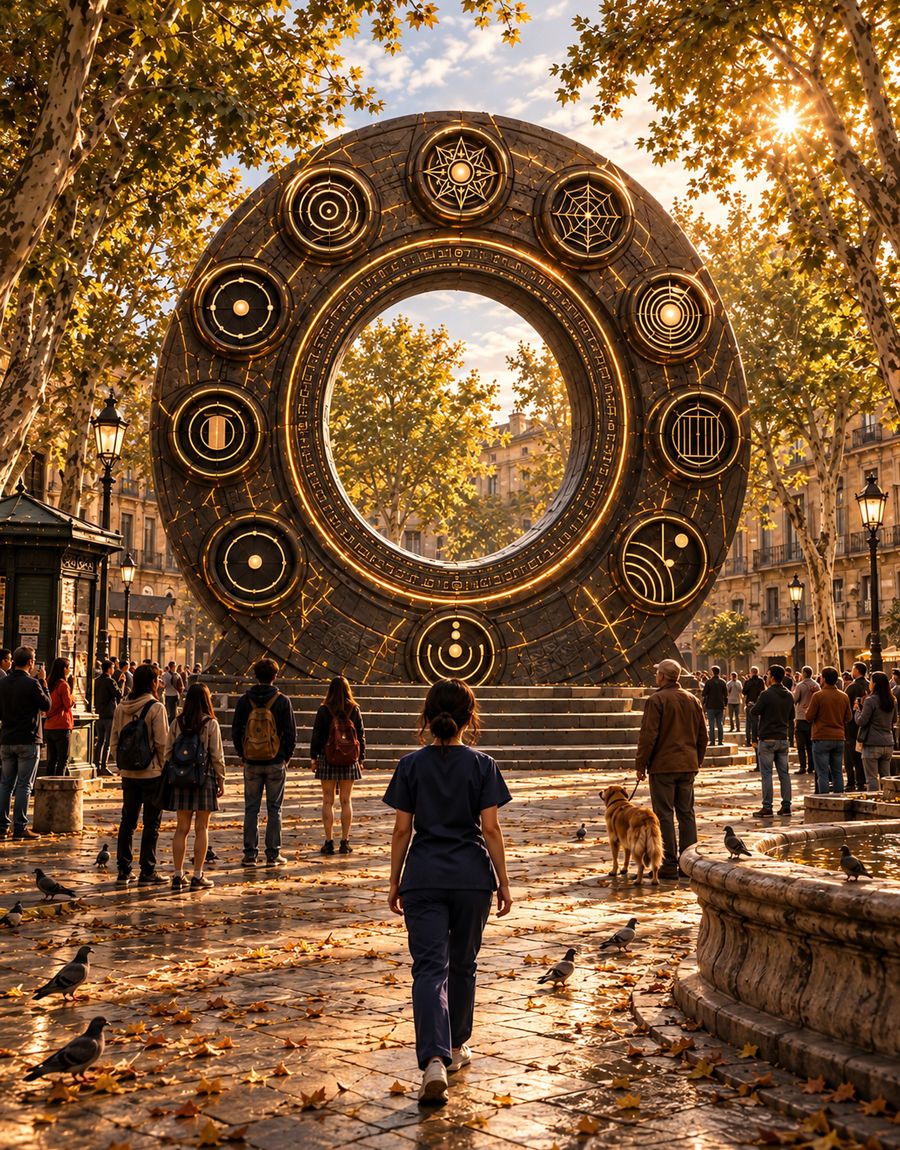
No one could say afterward, with any certainty, the exact moment it began. The accounts didn’t agree on the time, or on the sound—some would swear they had heard a low hum, like a very distant engine; others would insist there had been no sound at all, that the silence itself had grown, for a while, denser than usual. The only thing everyone agreed on was the place: the neighborhood’s old square, the one with the plane trees and the fountain that had been dry for years, the one people crossed every day without looking at it, the way you look at anything that has always been there.
It was midafternoon. The sun slanted across the stone benches, and a couple of pigeons pecked at crumbs beside the closed newsstand. Everything was, to all appearances, a day like any other.
And then, without anyone being able to say what exactly had changed, something in the air of the square felt different. It wasn’t a flash of lightning or a tremor. It was more like the moment you walk into a room and know, without needing to look, that someone else is in there.
Where before there had been only cracked paving stones and the long shadow of the plane trees, a silhouette began to rise. It did not appear all at once—the few witnesses to that first minute would agree, later, that it was like watching a dune grow in the wind: something that builds up without anyone being able to point to the exact instant it began to exist. Dark metal, almost black, veined with golden lines that seemed to breathe more than shine, rose from the very center of the old square, taking the shape of a circular structure as tall as a three-story building, whose edges never quite came into focus, as if the very idea of an “edge” had trouble applying to it.
At its center, a great circle—an immense ring, so large that a grown man could have stood inside its diameter ten times over—turned slowly, without a sound, without touching anything that might have held it up. Around that central ring, ten marks were set in a perfect arc, each one different, each one holding, though no one knew it yet, a number.
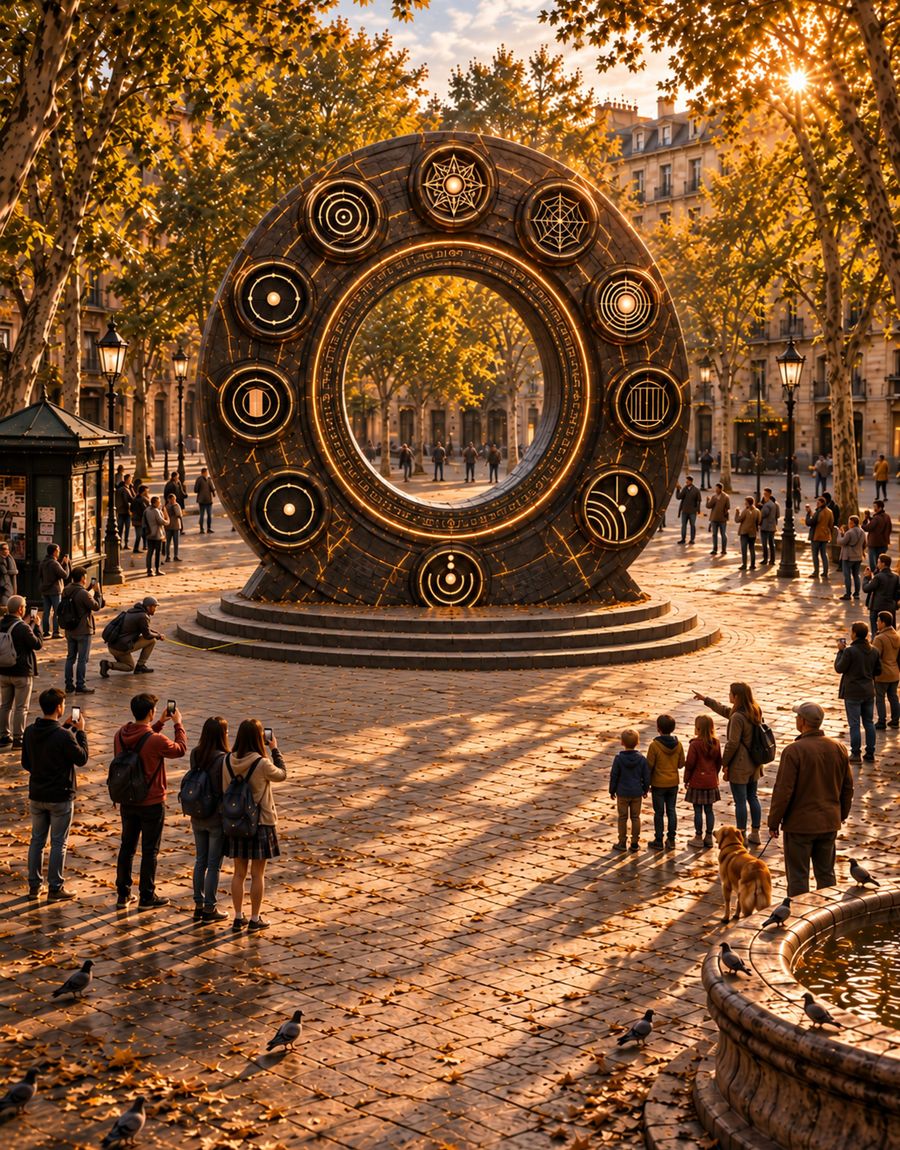
The first to notice were a group of teenagers on their way home from school, who stopped short half a block away, backpacks hanging from one shoulder, unsure whether to go closer or run. Then came an older man walking his dog, who stood still with the leash slack in his hand, looking at it with a mix of wonder and the vague suspicion that, at his age, nothing should surprise him anymore. Little by little, the old square began to fill with people who stopped, took out their phones, and spoke in low voices to the stranger beside them, as if a normal speaking voice had suddenly become out of place in front of it.
No one went near it, at first. The structure gave off no sense of threat—there was nothing aggressive about its presence, no vibration that made your teeth ache, no lights that blinded—but it had the silent weight of things too large to understand at a glance, and that weight alone was enough to keep the crowd at a cautious distance, forming a wider and wider circle around the circle of metal.
As evening fell, when the sun was already brushing the rooftops and the shadows of the plane trees stretched long across the square, the machine—because by then everyone was calling it that, without knowing whether the name did it justice—was still there, motionless and enormous, its central ring turning without a sound, waiting for something the crowd did not yet know how to name.
2 · Those Who Dared
In the days that followed, the old square stopped being a place people simply passed through.
People came to look, to speculate, to photograph the structure from angles that had already become habit. Someone said it was a contemporary art installation, commissioned by the city without notice. Someone else, with great conviction and no proof, insisted it was a disguised telecommunications antenna. A group of children swore that at night the machine sang, although no adult had managed to hear anything like a song. The youngest came up to take pictures of themselves beside the ring, never daring to cross a certain invisible distance, as if the body knew something the mind had not yet quite admitted.
No one touched it.
They did everything else instead. They circled it from a distance, slowly, in wider and wider rings, like someone walking around a sleeping animal without knowing whether it is really asleep. A man arrived one morning with a measuring tape and left by midafternoon without having written anything down: every time he stretched it toward the structure, the edge he had chosen as his starting point was no longer exactly where he had left it. A woman sat every afternoon on the same bench, facing the ring, with a thermos of tea in her hands, and told no one what she was waiting to see.
And sooner or later, everyone ended up looking at the ten marks around the ring. Everyone had seen them, and no one could agree on what was engraved on them. Some swore they were letters from an ancient alphabet; others, that they were just notches with no meaning at all. A child insisted they were numbers, and no one paid any attention to him. The only thing everyone agreed on was what their own bodies told them whenever someone got too close: not yet. That this distance was not to be crossed without a reason, and none of them had one.
Until someone did.
It was a middle-aged man, the kind who arrives late to every trend and, for that very reason, sometimes arrives first to the things that matter. He came early one morning, when the square was still almost empty, slowly reached out his hand, like someone stroking the back of an unfamiliar animal, and touched the metal edge of the structure.
Nothing happened.
The metal was cold, ordinary, as much metal as any other metal, and the man pulled his hand away with a mixture of relief and disappointment, like someone who had expected a bolt of lightning and found only one more surface. Others, emboldened by his example, began to do the same in the days that followed: they rested their palm on it, counted to three, and took it away. The machine did not respond to any of them. It stayed there, imposing and indifferent, like a statue that only pretends to be alive.
And on the other side of that immense ring—on the other side, where the pale stone and sunless light of the Numiverse received every gesture from Earth the way you look through a very clean pane of glass—Masy was watching it all. He saw every hand that came near and every hand that pulled away with nothing. He saw those who came every afternoon just to look from a distance, never daring to cross that invisible line. And he waited, with the same patience with which he always waited, because he knew—he had known it since before the machine finished taking shape in the old square—that not everyone who touched the metal would feel anything. The metal did not respond to the hand. It responded to something else, harder to name, that very few hands carried with them at the exact moment of touching.
Nurse Luna came to the square one early morning, still in her uniform, still with the smell of a twelve-hour shift clinging to her skin. She had spent the whole night holding the hand of a patient who was not going to make it to morning, and she had known it since before her shift began, and still she had stayed, because staying was the only thing she knew how to do well. When she left the hospital, the sky was still dark, and her legs carried her—without her consciously choosing the way—across the old square on her way home, as she always did. She stopped in front of the structure without quite knowing why. She was too tired to be afraid, too empty to speculate like the others. She simply reached out her hand, almost without thinking, with the same automatic gesture with which she had reached out her hand so many times that night to hold someone who could not hold themselves up.
And the instant her palm touched the metal, something answered.
It was not a bolt of lightning, nor a blinding light. It was, rather, a brief warmth that rose up her arm, as if the machine had recognized, in her tiredness, something it had always been looking for. Ten numbers appeared before her eyes, none of them written anywhere; they found their places, one by one, and stayed still, in an order so clear and so much her own that it was as if it had just been born from her.
4 7 2 9 1 0 6 3 8 5
Several days later, in another, distant part of the city, Young Tomás found out about the machine on his phone, the way he found out about almost everything. He was in his room, surrounded by notes that were no longer much use to him, with the usual feeling—the feeling of not quite knowing what to do with the year that was about to begin—pressing on his chest more than usual. He watched the video someone had posted, the enormous, silent structure in the middle of the old square, and without quite knowing why, he closed his notebook, slung his backpack over his shoulder without thinking—the same one as always, the one with the broken hook—and went out. He walked a long way to the square with his hands in his pockets, glancing sideways at the people who came close and backed away without daring anything. He stayed like that for a while, watching, until the sun began to go down and the crowd thinned out. Then, almost without fully deciding to, he walked up to the edge of the structure and put his hand on the metal, hoping—without fully admitting it—that something, anything, would finally tell him what to do with his life.
The metal answered with the same brief warmth, the same sudden clarity: ten numbers that appeared before him, found their places, and stayed still, in an order that had just been born and could only be his. A series of ten numbers different from the ones it had given Nurse Luna days before:
6 3 9 4 8 1 5 7 2 0
The days went by, and then the weeks, and the old square was never the same again. People came from other neighborhoods, and then from other cities. Technicians from the city came, with hard hats and folders, measured what they could measure, and left without explaining anything. A university professor came and spoke for half an hour in front of a camera about materials that did not exist, and another one contradicted him the next day. The news called it five different things, and none of them stuck. Almost no one touched it anymore: the few who had tried said nothing happened, and curiosity slowly turned into a kind of respect.
Everyone wanted to know the same thing: what it was, where it had come from, and—this they said more quietly—whether, just as it had arrived from one moment to the next, it might also leave, any afternoon, without warning. There were people who crossed the square every morning just to make sure it was still there. And it was. The days went by, and the machine stayed in its place, its ring turning without a sound, never stopping even once, as if the city’s time had nothing to do with its own.
Little Mateo didn’t even know the machine meant anything. To him it was simply the big new thing in the square where he played every afternoon, an interesting obstacle for races with his friends, a cool shadow to hide in when the sun beat down. That afternoon he was playing tag, running between the stone benches, and in the chase—laughing, out of breath, with no thought bigger than not getting caught—he brushed past the edge of the structure with his hand open, in the same carefree way a child touches anything that crosses his path.
The warmth rose up his arm as gently as it had risen up Luna’s and Tomás’s, and Mateo stopped short in the middle of the race, looking at his hand as if something new had suddenly attached itself to his skin. Without even noticing how much time had passed, ten numbers appeared before him, and although he did not fully understand what they meant, he felt—with that simple certainty only children have—that they were his, in a way very few things had ever been before.
5 3 8 9 2 4 6 0 1 7
He read them and repeated them countless times, in both directions, and tried to change their order, without success. Each number stayed fixed in its place. From this exercise he concluded that they were the numbers from 0 to 9, with none repeated. After several attempts in which he could not change their order, he almost came to the conclusion that those ten numbers, in that order, must have a special meaning for him.
The three of them, each at their own moment, on their own day, felt the same thing right after the warmth and the numbers: the world around them seemed to stop for an instant, and the machine’s great central ring, which until then had only turned in silence with no apparent purpose, opened—not like a door that swings to one side, but as if the very air inside the circle had decided, at last, to stop being just air. And in that instant, which stopped only for the one who had touched the machine, each of them split in two without knowing it: something of each of them—what they had always been and still had no name—went on toward the ring, while Luna, Tomás, and Mateo lowered their hands, felt something they could not name, and went on their way. Luna went home after her shift; Tomás, back to his room full of notes; Mateo, back to chasing his friends, who never knew the game had stopped for an instant.
On the other side, on the pale stone of the Numiverse, Masy was already waiting for them. For all three at once, at three different points of that same vastness, without being divided: whole in each place, as if each arrival were the only one happening, and each of them carried their ten numbers, all from 0 to 9, but each in a different order.